|
ADD |
  
|
|
ADD |
|
Block that calculates the sum of the values of Value1 and Value2, storing the result in Result.
Ladder Representation
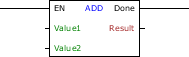
Block Structure
Variable Type |
Name |
Data Type |
Description |
VAR_INPUT |
EN |
BOOL |
Block enabling |
Value1 |
BYTE USINT SINT WORD UINT INT DWORD UDINT DINT REAL LREAL |
First addend of the operation |
|
Value2 |
BYTE USINT SINT WORD UINT INT DWORD UDINT DINT REAL LREAL |
Second addend of the operation |
|
VAR_OUTPUT |
Done |
BOOL |
End of operation |
Result |
BYTE USINT SINT WORD UINT INT DWORD UDINT DINT REAL LREAL |
Variable that stores the result of the operation |
Operation
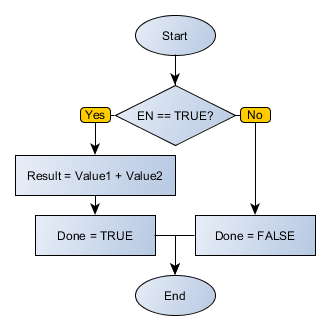
When this block has a TRUE value in EN, it sends to the Result output the sum of Value1 and Value2 variables. If no errors, the Done variable is set. If there is any error in the operation, Done is not set, staying in FALSE status, while Result remains with its value unchanged.
When EN has FALSE value, Result remains unchanged and Done remains in FALSE.
Block Flowchart
Example in Ladder
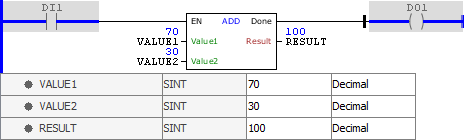
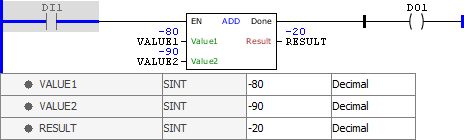
The above example calculates the sum of VALUE 1 and VALUE2 variables, storing the final result in RESULT.
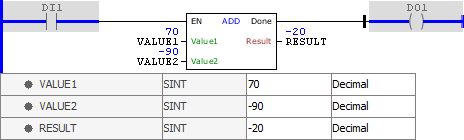
The above example calculates the sum of VALUE 1 and VALUE2 variables, storing the final result in RESULT. Notice that the block accepts arguments of both signs.
The above example calculates the sum of VALUE1 and VALUE2 variables. The final result -170 cannot be stored in RESULT, because it is outside the limits of accepted values by SINT type. Therefore, RESULT remains unchanged and the output is disabled.
Example in ST
The example below displays the instructions for applying the example above in the ST language.
VAR VALUE1 : SINT := 70; VALUE2 : SINT := -90; RESULT : SINT; END_VAR
RESULT := FB_ADD( EN:=DI1, Value1:=VALUE1, Value2:=VALUE2, Done=>DO1);
|
|---|