|
ROL |
  
|
|
ROL |
|
Block that performs a logical left rotation operation in a value passed by Value, storing the result in Result.
Ladder Representation
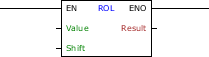
Block Structure
Variable Type |
Name |
Data Type |
Description |
VAR_INPUT |
EN |
BOOL |
Block enabling |
Value |
BYTE USINT SINT WORD UINT INT DWORD UDINT DINT |
Variable to undergo rotation |
|
Shift |
BYTE USINT |
Shift index |
|
VAR_OUTPUT |
ENO |
BOOL |
End of operation |
Result |
BYTE USINT SINT WORD UINT INT DWORD UDINT DINT |
Variable that stores the result of the operation |
Operation
When this block has a TRUE value in EN, it sends to the Result output the value of the Value variable after performing a number of logical left shifts, according to the Shift value. The most significant bits that are being discarded are returned to the least significant bits, characterizing the rotation.
When EN has FALSE value, Result remains unchanged.
The ENO value forwards to the next Ladder block the EN value after the operation is completed.
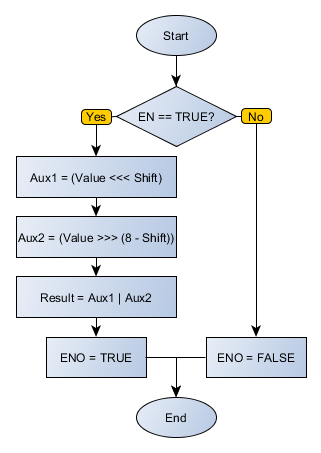
Block Flowchart
Example in Ladder
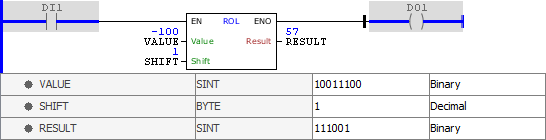
The above example performs a logical left shift by one position in the VALUE variable whose initial value is -100 (1001 1100 in binary). The discarded bits on the left are reinserted on the right. The final result (0011 1001 in binary) is stored in RESULT.
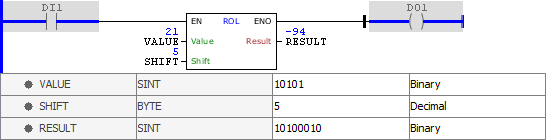
The above example performs a logical left rotation by five positions in the VALUE variable whose initial value is 21 (0001 0101 in binary). The discarded bits on the left are reinserted on the right. The final result (1010 0010 in binary) is stored in RESULT.
Example in ST
The example below displays the instructions for applying the example above in the ST language.
VAR VALUE : USINT := 2#0001_0101; SHIFT : BYTE := 5; RESULT : USINT; END_VAR
RESULT := FB_ROL( EN:=DI1, Value:=VALUE, Shift:=SHIFT, ENO=>DO1);
|