|
MUX |
  
|
|
MUX |
|
Block that creates a new WORD variable from the concatenation of 16 BOOL variables.
Ladder Representation

Block Structure
Variable Type |
Name |
Data Type |
Description |
VAR_INPUT |
EN |
BOOL |
Block enabling |
Bit0 – Bit15 |
BOOL |
Bit of the corresponding position in the new word |
|
VAR_OUTPUT |
ENO |
BOOL |
End of operation |
Word |
WORD UINT INT |
New word formed from the input bits |
Operation
When this block has a TRUE value in EN, it concatenates Boolean values of the input variables and stores this value in the variable Word. Bit0 corresponds to LSB (least significant bit) and Bit15 corresponds to the MSB (most significant bit).
When EN has FALSE value, Word remains unchanged.
The ENO value forwards to the next Ladder block the EN value after the operation is completed.
Block Flowchart

Example in Ladder
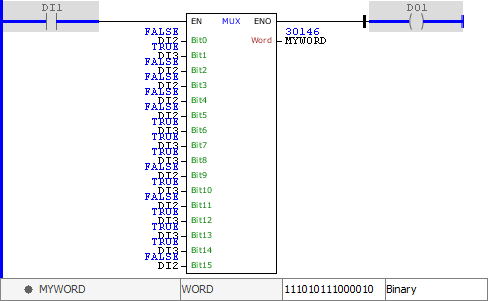
The above example concatenates the Boolean values of the input bits of the block to form the output word stored in MYWORD. The block ends with success and ENO output is activated.
Example in ST
The example below displays the instructions for applying the example above in the ST language.
VAR MYWORD : WORD; END_VAR
MYWORD := FB_MUX( EN:=DI1, Bit0:=DI2, Bit1:=DI3, Bit2:=DI2, Bit3:=DI2, Bit4:=DI2, Bit5:=DI2, Bit6:=DI3, Bit7:=DI3, Bit8:=DI3, Bit9:=DI2, Bit10:=DI3, Bit11:=DI2, Bit12:=DI3, Bit13:=DI3, Bit14:=DI3, Bit15:=DI2, ENO=>DO1);
|
|---|