|
BYTES_TO_DWORD Convert Bytes to Double Word |
  
|
|
BYTES_TO_DWORD Convert Bytes to Double Word |
|
Block that performs the conversion of four 8 bits (BYTE) values into a 32 bits (DWORD) value.
Ladder Representation
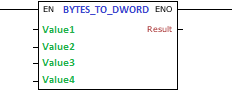
Block Structure
Variable Type |
Name |
Data type |
Description |
VAR_INPUT |
EN |
BOOL |
Block enabling |
Value1 |
BYTE USINT SINT |
Value in BYTE (1st byte - LSB) |
|
Value2 |
BYTE USINT SINT |
Value in BYTE |
|
Value3 |
BYTE USINT SINT |
Value in BYTE |
|
Value4 |
BYTE USINT SINT |
Value in BYTE (4th byte - MSB) |
|
VAR_OUTPUT |
ENO |
BOOL |
End of operation |
Result |
DWORD UDINT DINT |
Value in DWORD |
Operation
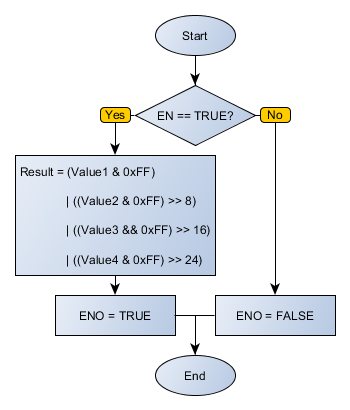
When this block has a TRUE value in EN, it interprets the Value1, Value2, Value3 and Value4 values as BYTE and converts it into a DWORD variable, storing in Result.
When EN has FALSE value, Result remains unchanged.
The ENO value forwards to the next Ladder block the EN value after the operation is completed.
Block Flowchart
Example in Ladder
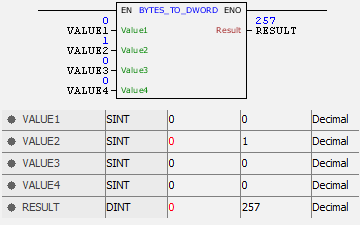
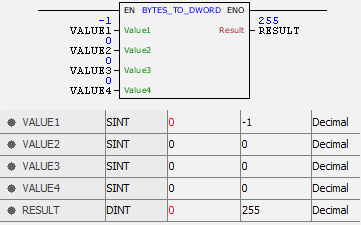
The examples above perform the conversion of four variables VALUE1..4, in BYTE, into a DWORD value storing the final result in RESULT. The block ends with success and ENO output is activated.
Example in ST
The example below displays the instructions for applying the example above in the ST language.
VAR VALUE1 : SINT := 0; VALUE2 : SINT := 1; VALUE3 : SINT := 0; VALUE4 : SINT := 0; RESULT : DINT; END_VAR
RESULT := FB_BYTES_TO_DWORD( EN:=DI1, Value1:=VALUE1, Value2:=VALUE2, Value3:=VALUE3, Value4:=VALUE4, ENO=>DO1);
|
|---|